
User experience in 2026 is no longer just about how a website looks, it’s about how intelligently it behaves. Websites today are expected to anticipate needs, reduce friction, and create meaningful digital interactions. If your site simply “exists” online without evolving, users won’t hesitate to leave. UX is no longer a design upgrade; it’s a growth strategy.
As we move deeper into 2026, we’re seeing a clear shift toward smarter, faster, and more human-centered digital experiences. Businesses that invest in modern UX trends are seeing higher engagement, stronger trust, and better conversions. Businessesthat ignore it risklosing visibility and relevance.
Let’s explore the UX trends shaping 2026 websites and what they really mean for your business.
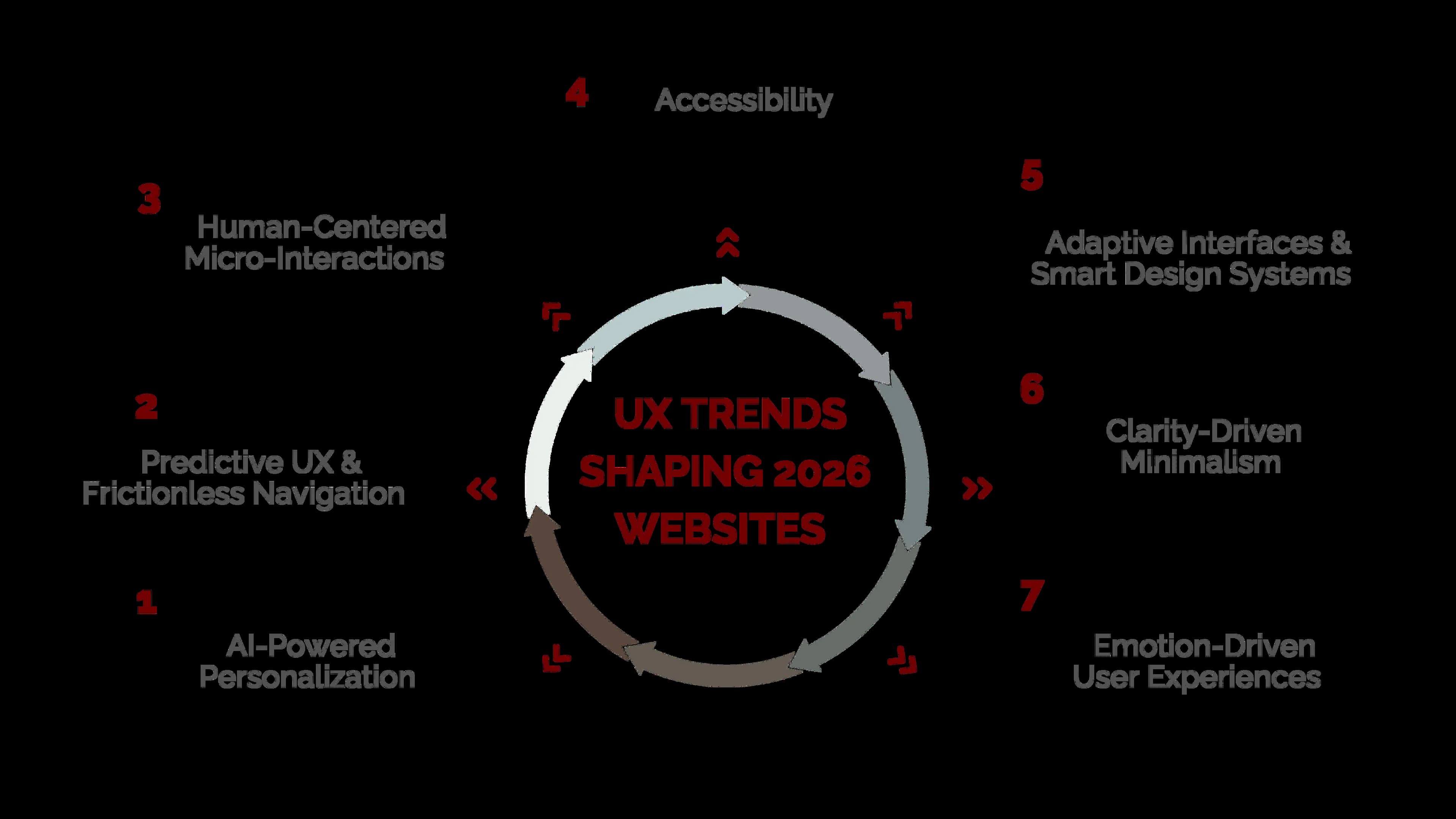
AI-Powered Personalization That Feels Natural
Personalization used to mean adding a “recommended for you” section. In 2026, it’s far more advanced and far more subtle.
Today’s AI-powered UX adapts in real time based on behavior and intent. Websites can now adjust content, layout, and calls-to-action based on a visitor’s behaviour. If someone spends time reading service pages, the homepage might dynamically prioritise case studies. If they’re browsing pricing, the site may present tailored offers or FAQs that address hesitation points.
In 2026, ipersonalization no longer feels robotic. It feels intuitive. When we implement AI-driven UX strategies, the goal isn’t to overwhelm users with automation. It’s to simplify their journey. Smart personalization reduces decision fatigue and shortens the path to conversion, where real impact happens.
Predictive UX & Frictionless Navigation
One of the strongest UX trends shaping 2026 websites is predictive design. Instead of waiting for users to search, scroll, and click repeatedly, websites are now anticipating their next move.
Think about how frustrating long forms and complex checkouts used to be. In 2026, predictive UX minimizes that effort. Intelligent autofill, contextual suggestions, simplified checkout flows, and dynamic navigation menus are becoming the norm. When a website predicts what a user needs and presents it at the right time, the entire experience feels seamless.
Reducing friction directly improves conversion rates. The less work users have to do, the more likely they are to complete an action, whether that’s signing up, booking a service, or making a purchase.
Conversational Interfaces & Human-Centered Micro-Interactions
Websites are becoming more conversational in 2026. Instead of rigid interfaces, users are interacting with brands through chat-based layouts, AI assistants, and voice-enabled features.
But it’s not just about chatbots.
It’s about micro-interactions, those small design details that respond instantly to user behavior. A button that subtly animates when clicked. A progress bar that visually reassures users during checkout. A hover effect that provides additional context.
These details might seem minor, but they shape perception.
When a website responds in real time, it builds confidence. It feels modern. It feels alive. And most importantly, it feels trustworthy.
In 2026, digital experiences that feel like conversational build stronger engagement than transactional ones.
Accessibility as a Core UX Standard
Accessibility is no longer optional. It’s foundational.
Modern UX design in 2026 prioritizes inclusive digital experiences that work for everyone, including users with visual impairments, hearing challenges, mobility limitations, or cognitive differences.
This includes clear contrast ratios, readable typography, logical navigation structures, and keyboard-friendly layouts. It also includes thoughtful content design - simpler language, structured formatting, and clear instructions.
The truth is, accessible websites don’t just help a specific group. They improve usability for all users.
When we integrate accessibility into our UX process, we’re not just meeting compliance standards. We’re expanding reach, building trust, and future-proofing digital platforms.
Adaptive Interfaces & Smart Design Systems
Dark mode is now expected, but in 2026, adaptive design goes beyond color themes.
Websites are adjusting automatically based on device type, time of day, user preferences, and even environmental lighting conditions. These subtle adaptations create comfort and usability without requiring manual settings.
An adaptive UX system recognizes context. For example, mobile users may see simplified navigation and larger interactive elements, while desktop users experience more detailed layouts. These adjustments are guided by behavioral data, not guesswork.
We believe the best UX doesn’t force users to adjust. It adjusts for them.
Clarity-Driven Minimalism
Minimalism in 2026 is more strategic than aesthetic.
It’s not just about empty space, it’s about intentional focus. Users are overwhelmed with digital noise. The websites that succeed are the ones that remove distractions and prioritize clarity.
Clear messaging, strong visual hierarchy, and simplified layouts allow users to process information quickly. When users understand what to do within seconds, engagement increases dramatically.
Simplifying design consistently leads to better results. When navigation is obvious and messaging is direct, decision-making becomes effortless.
In modern UX design, clarity is conversion.
Emotion-Driven User Experiences
Emotional design is one of the most underestimateddrivers of UX performance in 2026.
People don’t just remember functionality, they remember how a digital experience made them feel.
Storytelling, authentic brand voice, thoughtful microcopy, and meaningful visuals all contribute to emotional connection. Instead of generic stock messaging, brands are embracing personality and relatability.
Users want to feel understood. When we design websites, we ask: What emotion should this page evoke? Confidence? Excitement? Trust?
Because when users feel something, they stay longer. And when they stay longer, engagement grows.
Performance as a UX Priority
Speed has always mattered, but in 2026, performance is directly tied to brand perception and SEO rankings.
Users expect pages to load instantly. Even a two-second delay can significantly increase bounce rates.
Optimized images, lightweight development frameworks, and performance-focused coding practices are no longer backend concerns; they are UX essentials.
Search engines also prioritize fast, mobile-friendly websites through Core Web Vitals metrics. Improving performance doesn’t just enhance user experience, it strengthens search visibility.
At Seven Koncepts, we treat performance as part of design, not an afterthought.
Privacy-First User Experience
Data awareness has changed user expectations. Visitors want transparency. Websites in 2026 are shifting toward clear privacy policies, simplified consent forms, and minimal data collection practices. Instead of overwhelming pop-ups, brands are designing privacy notices that are clear and non-intrusive.
Trust is now a key conversion factor.
When users feel their data is respected, they are more likely to engage. A privacy-first UX approach signals professionalism and responsibility.
Clarity builds trust - and trust drives long-term growth.
Why UX Trends in 2026 Matter More Than Ever
These UX trends shaping 2026 websites aren’t temporary design patterns. They reflect a broader shift in user behavior.
Modern users expect:
- Instant responses
- Personalized journeys
- Seamless navigation
- Mobile optimization
- Transparency
If a website fails to meet these expectations, users leave - often within seconds. UX now influences everything: SEO performance, engagement rates, brand perception, and revenue growth. It’s not just a design decision. It’s a business strategy.
When we invest in user experience, we’re investing in long-term scalability.
Future-Proof Your Website with Seven Koncepts
At Seven Koncepts, we don’t just follow UX trends, we implement them strategically. We analyze user behavior, build conversion-focused structures, optimize performance, and design digital experiences that are intuitive, inclusive, and future-ready. Every website we create is built with growth in mind.
If your current website feels outdated, slow, or disconnected from user expectations, 2026 is the year to evolve.
Let’s design a digital experience that performs as intelligently as it looks.
Connect with Seven Koncepts today and let’s build a website that leads, not follows.
FAQs
1. What are the most important UX trends shaping 2026 websites?
AI-powered personalization, predictive navigation, accessibility-first design, adaptive interfaces, performance optimization, and privacy-focused UX are leading trends.
2. How does UX impact SEO in 2026?
User experience directly affects bounce rates, time on site, mobile usability, and Core Web Vitals, all of which influence search engine rankings.
3. Is AI necessary for modern website UX?
While not mandatory, AI significantly enhances personalization and predictive user journeys, making websites more efficient and engaging.
4. Why is accessibility essential in modern UX design?
Accessible websites reach a broader audience, improve usability for everyone, and align with global compliance standards.
5. How often should UX be updated?
UX performance should be reviewed annually, with continuous testing and optimization throughout the year.