
When it comes to managing a marketing budget, one of the biggest challenges businesses face is deciding how to allocate funds effectively across the different stages of the customer journey. Whether you’re running digital marketing campaigns, launching content marketing funnels, or simply optimizing your ad budget, the key to success lies in understanding how to structure your marketing budget across the Top of Funnel (TOF), Middle of Funnel (MOF), and Bottom of Funnel (BOF) stages.
In this blog, we’ll dive into these three crucial stages of the funnel strategy, explaining how to allocate your budget wisely to achieve the best possible results. By the end, you’ll have a clearer understanding of how to balance your marketing budget for each funnel stage to drive conversions and maximize ROI.
The Funnel Strategy: Understanding TOF, MOF, and BOF
Before we jump into budget allocation, let's quickly review what each stage of the funnel marketing strategy means.
-
Top of Funnel (TOF): This is the awareness stage. Here, you're casting a wide net to attract new leads and drive traffic to your website or landing page. The focus at this stage is on creating awareness and reaching as many potential customers as possible.
-
Middle of Funnel (MOF): At this stage, prospects are already aware of your brand, and they’re evaluating your products or services. Here, your goal is to nurture these leads, build trust, and provide valuable content to guide them closer to making a purchase decision.
-
Bottom of Funnel (BOF): This is the decision stage. The prospects in this stage are ready to convert, so your focus is on encouraging them to take action, whether it’s making a purchase, signing up, or becoming a loyal customer.
Now that you understand the basics of the funnel, let’s look at how to allocate your marketing budget to each stage to achieve the best possible results.
Smart Budget Allocation: Where to Spend Your Marketing Budget
When creating a marketing budget example for your digital campaigns, it’s important to ensure that you’re not overspending at one stage while neglecting others. Here’s a breakdown of how to allocate your marketing budget across each funnel stage:
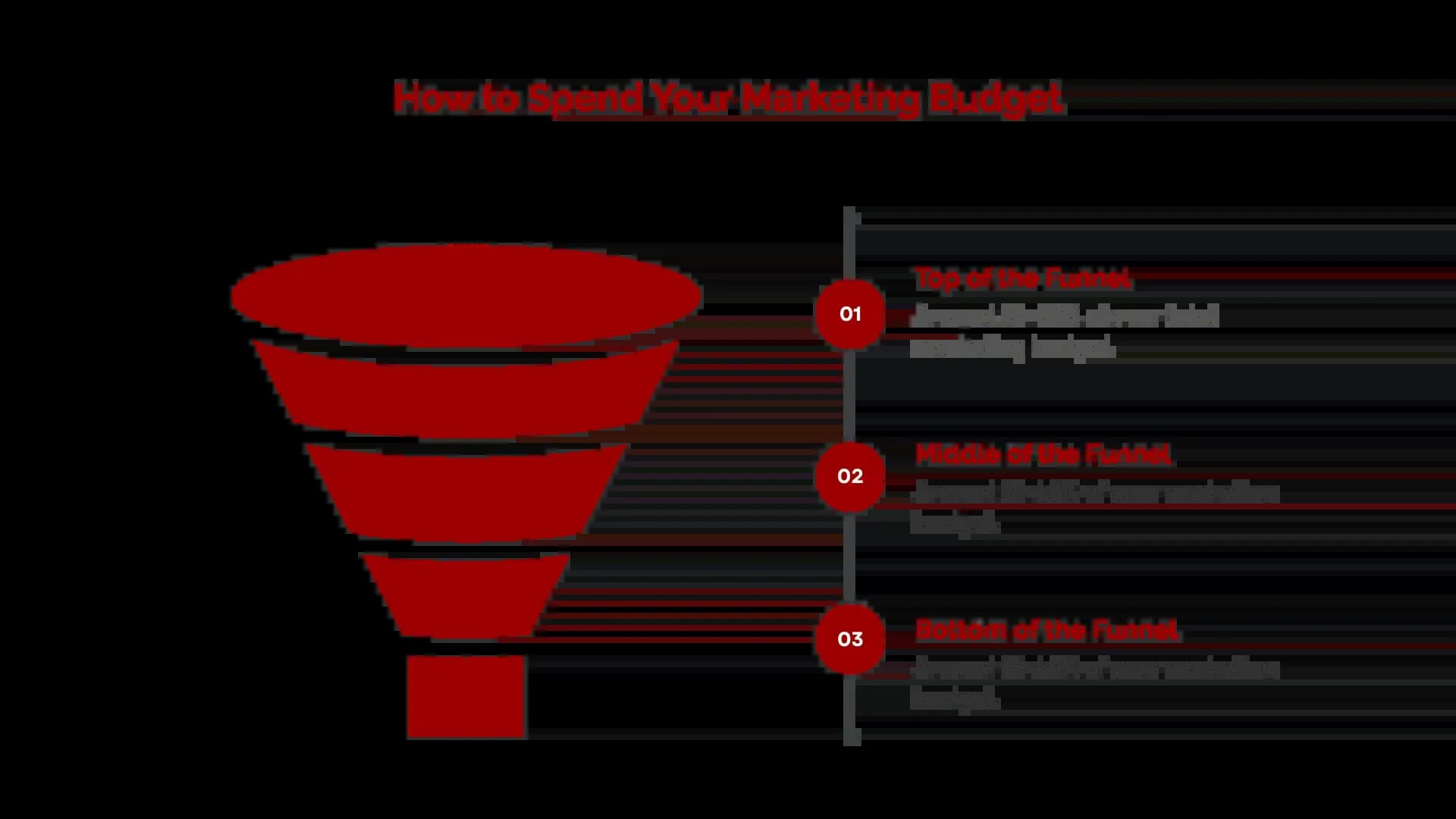
1. Top of Funnel (TOF): Awareness and Lead Generation
At the TOF, your goal is to introduce your brand to a large audience. You’re not trying to convert yet - your goal is to capture attention and spark engagement.
Recommended Budget Allocation:
- Around 50-60% of your total marketing budget.
- Why? Because awareness is the first step in any customer journey. Without awareness, you won’t have anyone to nurture through the funnel.
How to Spend It:
- Paid ads: Run paid campaigns - Google , Facebook or LinkedIn Ads - to reach wide audiences quickly.
- Content marketing is also crucial — blogs, short-form videos and social media posts attract people their discovery phase.
- SEO optimization for your website or landing pages will improve your organic search visibility, helping you reach potential customers who are actively searching for solutions.
Key TOF Metrics to Track:
- Impressions
- Click-through rate (CTR)
- Website traffic
- Social media engagement
2. Middle of Funnel (MOF): Nurturing and Relationship Building
Once you’ve attracted your audience, the next step is nurturing those leads. They may have engaged with your content, but they’re still deciding whether or not your product or service fits their needs.
Recommended Budget Allocation:
- Around 30-35% of your marketing budget.
- Why? While TOF focuses on broad reach, MOF aims to nurture leads, so it requires a slightly smaller portion of the budget. However, this is where you’ll see more personalized interactions.
How to Spend It:
- Email marketing campaigns: Start building your email list and send nurturing content that addresses their pain points and provides solutions.
- Remarketing ads: Targeting users who engaged with your TOF content (website visitors, social media followers) but haven’t yet converted. Remarketing ads are highly effective at keeping your brand top-of-mind.
- Webinars and lead magnets: Offer free resources like eBooks, whitepapers, or webinars to continue educating your leads and show them the value of your offering.
Key MOF Metrics to Track:
- Email open and click rates
- Conversion rates from lead magnets
- Engagement with nurturing content (webinars, case studies, etc.)
3. Bottom of Funnel (BOF): Converting Leads into Customers
At the BOF, your prospects are close to making a purchase decision. They know your brand, your offer, and how you stack up against your competitors. This stage is all about turning those warm leads into paying customers.
Recommended Budget Allocation:
- Around 10-20% of your marketing budget.
- Why? By the time a lead reaches the BOF, they’re already familiar with your brand. Here, you want to spend your budget efficiently to convert those leads into customers with minimal friction.
How to Spend It:
- Conversion rate optimization (CRO): Invest in tools or strategies that improve the user experience on your website, such as A/B testing or optimizing your checkout process.
- Incentives and offers: Use limited-time discounts, special offers, or free trials to motivate prospects to take the final step.
- Sales team support: Equip your team with follow-up tools to close warm leads efficiently.
Key BOF Metrics to Track:
- Conversion rates
- Return on ad spend (ROAS)
- Customer acquisition cost (CAC)
Why Balanced Budget Allocation is Key
A balanced marketing budget ensures prospects keep moving smoothly through every funnel stage. Focusing too much on one stage can result in an unbalanced funnel. For example, overspending at TOF while neglecting MOF or BOF leaves you with plenty of leads - but few conversions. Similarly, over-spending at the BOF can lead to high acquisition costs without sufficient new leads entering the funnel.
By spreading your budget across the funnel, you create a balanced, sustainable full funnel marketing strategy that maximizes your reach and optimizes conversions. With the right balance, you can continuously feed your sales pipeline while nurturing and converting high-quality leads.
Conclusion
Smart budget allocation is not just about where to spend - it’s about how to measure, optimize, and adapt. Use data from each funnel stage to adjust your marketing campaigns and continuously improve your ROI. Whether you’re in the awareness stage, nurturing leads, or pushing for conversions, remember that your marketing budget should be flexible and adapt to what the data is telling you.
Ready to make smarter decisions with your marketing budget? At Seven Koncepts, we help businesses create balanced, results-driven strategies that align organic efforts with performance-focused PPC services for maximum impact. Contact us today to learn how we can help you optimize your marketing budget and improve your funnel strategy.
FAQs
1. How should I allocate my marketing budget for a new product launch?
For a new product launch, you should allocate a larger portion of your budget to the Top of Funnel (TOF) to create awareness and drive traffic. Consider spending about 50% of your budget on TOF efforts, with a smaller portion directed toward MOF and BOF as you start converting leads.
2. What are the best ways to optimize the middle of the funnel?
Optimizing MOF involves creating valuable content, personalized email marketing, and using remarketing ads to stay top-of-mind. Make sure your content addresses your leads' pain points and offers them solutions that move them closer to conversion.
3. How do I track the success of my funnel marketing strategy?
Track the success of your funnel marketing strategy by measuring key metrics at each stage, such as CTR for TOF, conversion rates for MOF, and customer acquisition cost (CAC) for BOF. Use tools like Google Analytics, CRM software, and email marketing platforms to monitor performance and make data-driven decisions.
4. How can I make my full funnel marketing strategy more effective?
A successful full funnel marketing strategy involves aligning your content with the needs of your audience at each stage. Regularly analyze your funnel stages, test different tactics, and make adjustments based on data to ensure a seamless journey for your leads.