
Building a marketing tech stack that works is not about collecting tools. It is about creating a system that helps us attract the right audience, understand their behaviour, and turn interest into measurable growth. Too many businesses invest in marketing software hoping it will magically fix performance. What drives results is how thoughtfully those tools are chosen, connected, and used.
In this blog, we will walk through how we build a marketing tech stack that actually supports strategy, simplifies execution, and scales with growth.
What a Marketing Tech Stack Really Means
A marketing tech stack is the combination of platforms and tools we use to plan, execute, track, and optimize marketing activities. This includes everything from analytics and automation to customer data and content management.
A working tech stack should help us:
- Understand our audience better
- Automate repetitive tasks
- Measure performance accurately
- Improve decision making
- Scale campaigns without chaos
The goal is clarity and efficiency, not complexity.
Why Most Marketing Tech Stacks Fail
Before we talk about building the right stack, it helps to understand why so many fail.
Common reasons include:
- Tools are purchased without a clear strategy
- Platforms do not integrate effectively
- Teams use only a fraction of features
- Data lives in silos
- Reporting is fragmented and unclear
Often, companies end up with powerful software that never delivers value because it is not aligned with actual business goals.
Start With Strategy, Not Software
The biggest mistake we see is choosing tools first and defining goals later. A marketing tech stack should be built around what we want to achieve.
Before selecting any platform, we ask questions like:
- What are our primary marketing goals?
- Are we focused on lead generation, brand growth, or retention?
- Which channels matter most to our audience?
- How do we define success?
Once these answers are clear, technology becomes a support system instead of a distraction.
Core Components of a Marketing Tech Stack That Works
While every business is different, the most effective stacks include a few essential layers.
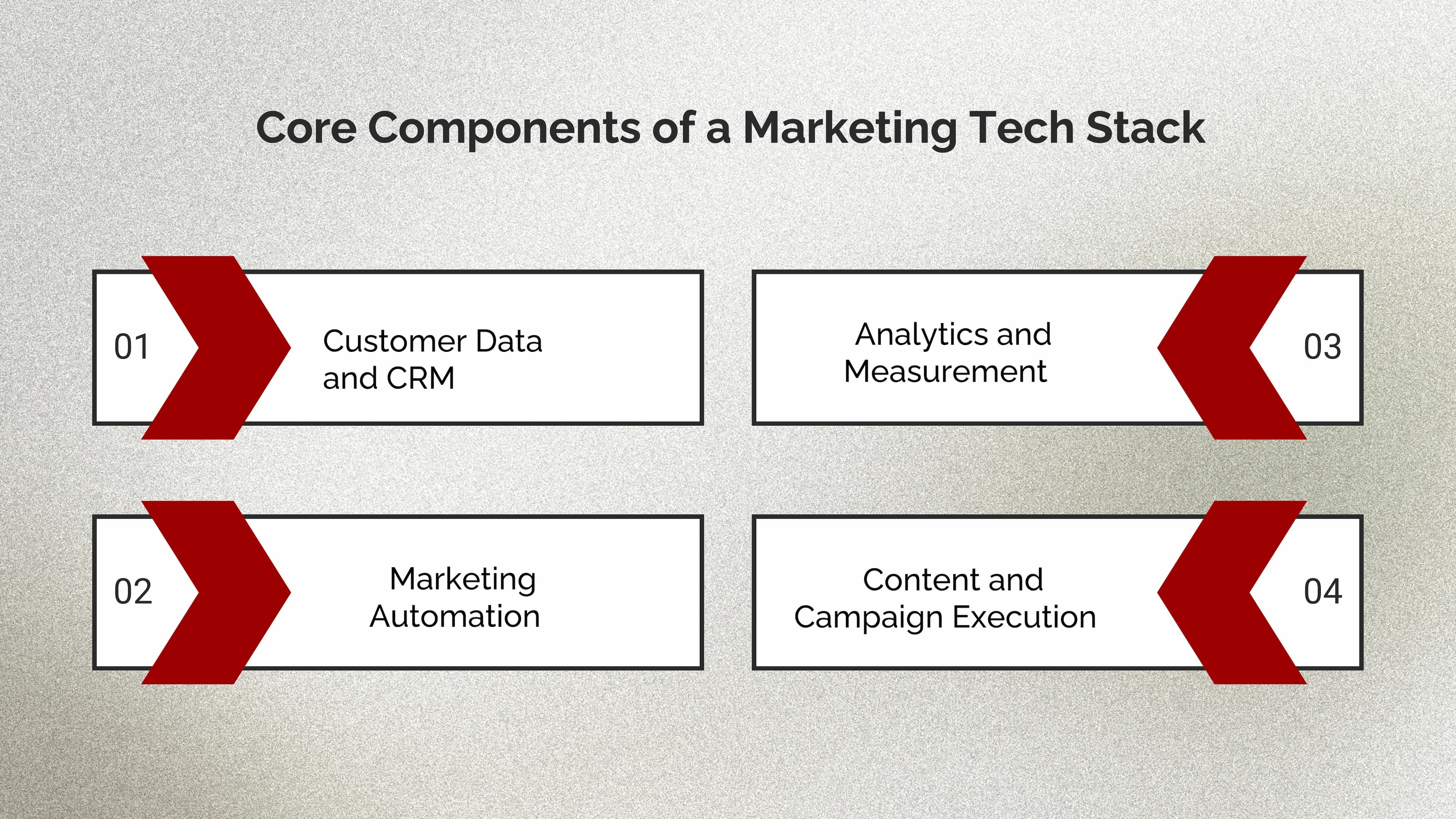
1. Customer Data and CRM
A strong customer relationship management system is the foundation. It centralises customer data and gives us a single source of truth.
A well known example is Salesforce, which helps businesses track leads, manage pipelines, and understand customer journeys across touchpoints.
Key benefits include:
- Unified customer profiles
- Better sales and marketing alignment
- Smarter personalization
2. Analytics and Measurement
If we cannot measure performance, we cannot improve it. Analytics tools help us understand what is working and what is not.
Google Analytics is a widely used example that allows us to track website behavior, traffic sources, and conversion paths.
Analytics helps us:
- Identify high performing channels
- Understand user behaviour
- Optimize campaigns in real time
3. Marketing Automation
Automation saves time and ensures consistency. It allows us to nurture leads, personalise communication, and trigger actions based on behaviour.
Platforms like HubSpot combine CRM, email marketing, and automation into one ecosystem.
With automation, we can:
- Send timely follow ups
- Segment audiences dynamically
- Scale campaigns without increasing workload
4. Content and Campaign Execution
Content sits at the heart of modern marketing. We need tools that help us manage, distribute, and optimize it across channels.
Email platforms such as Mailchimp allow us to create targeted campaigns, test messaging, and track engagement.
Effective content tools help us:
- Maintain brand consistency
- Personalize communication
- Improve engagement rates
Integration Is What Makes the Stack Work
A tech stack is only as strong as the connections between the tools. Integration ensures data flows smoothly across platforms.
When tools are integrated properly:
- Leads move automatically from forms to CRM
- Campaign data feeds into analytics
- Customer behaviour informs automation workflows
- Reporting becomes centralised
Without integration, even the best tools create friction instead of efficiency.
Keep the Stack Simple and Scalable
More tools do not mean better marketing. In fact, complexity often slows teams down.
When building a stack, we focus on:
- Ease of use for the team
- Clear ownership of each tool
- Tools that can grow with the business
- Avoiding feature overlap
A lean, well-aligned stack outperforms a bloated one every time.
Real Brand Examples of Smart Tech Stacks
Large brands succeed with marketing technology not because they use more tools, but because they use them strategically.
-
Netflix is a great example. Its marketing systems are deeply connected to user behavior data, allowing hyper personalized recommendations and campaigns.
-
Shopify empowers small and medium businesses by integrating analytics, email, payments, and CRM into one ecosystem, reducing complexity for growing brands. The lesson is clear. Success comes from alignment, not volume.
How We Approach Marketing Tech Strategy
At Seven Koncepts, we believe marketing technology should serve strategy, not replace it. Our approach focuses on clarity, integration, and performance.
When we help brands build or optimize their marketing tech stack, we focus on:
- Business goals first
- Data driven decision making
- Seamless tool integration
- Long-term scalability
We see the tech stack as a growth engine, not a software checklist.
Common Mistakes to Avoid
As we build or refine a marketing tech stack, there are a few pitfalls worth avoiding.
- Buying tools because competitors use them
- Ignoring team training and adoption
- Failing to review performance regularly
- Treating tools as standalone solutions
Technology works best when people, processes, and strategies are aligned.
The Future of Marketing Tech Stacks
Marketing technology is moving toward intelligence driven systems. AI, predictive analytics, and automation are becoming standard.
In the future, working tech stacks will:
- Deliver real-time insights
- Adapt campaigns automatically
- Personalize experiences at scale
- Reduce manual decision making
Brands that invest thoughtfully today will be better positioned to compete tomorrow.
Ready to Build a Stack That Actually Delivers?
A marketing tech stack should make growth easier, not harder. When built correctly, it becomes a powerful system that drives clarity, efficiency, and measurable results. At Seven Koncepts, we help brands design and implement marketing technology ecosystems that support digital marketing strategy, performance marketing, marketing automation, analytics integration, and long term brand growth.
If you are looking to simplify your tools, improve ROI, or build a scalable marketing system, Seven Koncepts is here to help. Let’s turn your technology into a growth advantage.
FAQs
1. What is a marketing tech stack in simple terms?
A marketing tech stack is the set of tools used to manage marketing activities, track performance, and engage customers across channels.
2. How many tools should a marketing tech stack include?
There is no fixed number. The right stack includes only the tools needed to achieve specific goals without unnecessary overlap.
3. Can small businesses build an effective tech stack?
Yes. Even small teams can build powerful stacks using scalable and affordable tools, as long as they focus on strategy first.
4. How often should a tech stack be reviewed?
We recommend reviewing it at least once or twice a year to ensure tools are still aligned with business goals.
5. Does a strong tech stack replace marketing strategy?
No. Technology supports strategy. It does not replace clear thinking, creativity, or human decision making.