
When it comes to creating content that actually converts, one question keeps coming up: Should you focus on long-form content or short-form content? As brands compete for attention across social media, search engines, and every corner of the internet, choosing the right format can directly impact how effective your content marketing strategy actually is. And here’s the truth, both formats work, but not in the same way. The real magic happens when you know when to use long-form, when to use short-form, and how both support your brand’s goals.
In this blog, we’re breaking everything down in a conversational, no-fluff way so you walk away with a clearer content plan and a better understanding of what truly drives conversions.
Long-Form vs. Short-Form Content: What “works”
Before we pick a side, we should ask one question:
What job do we need this piece of content to do?
- If the job is to educate, build trust, rank on Google, and overcome objections, long-form usually wins.
- If the job is to grab attention, create demand, and push a next step quickly, short-form often wins.
The conversion mistake most brands make is using the right format for the wrong job, trying to close a sale with a 30-second post, or trying to rank for a competitive keyword with a 300-word article.
What counts as long-form vs short-form?
There’s no universal rule, but here’s a practical way to define it for marketing:
Long form content
Usually 1,200–3,000+ words (blogs, guides, landing page deep dives, case studies, pillar pages).
It’s built to:
- answer questions thoroughly
- rank for search intent
- support decision-making
Short form content
Usually under 800 words (social posts, emails, short landing sections, product updates, FAQs, Reels/TikToks, short articles).
It’s built to:
- be consumed fast
- generate curiosity and clicks
- move someone to a micro-action
Both convert, just not the same people, not the same way, and not for the same reasons.
How long-form content drives conversions (and why it’s still a powerhouse)
Long form content converts because it reduces uncertainty. When someone is considering a purchase, their brain runs through objections:
- “Is this legit?”
- “Will it work for me?”
- “What will it cost me; money, time, risk?”
- “What happens if I choose wrong?”
A well-built long-form piece answers those questions before a sales call or checkout ever happens.
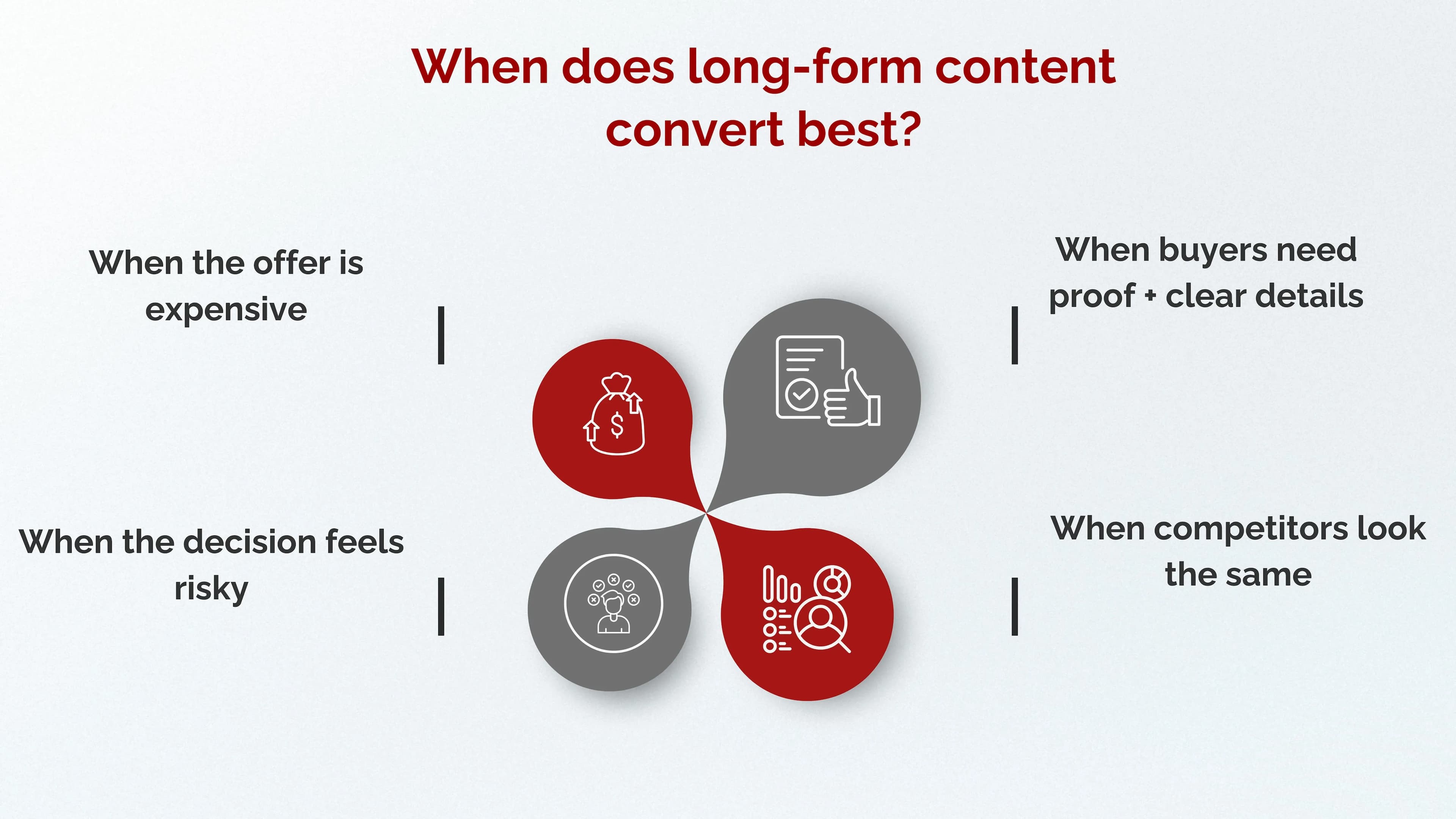
Conversion advantages of long-form
Here’s what long-form does better than almost anything else:
-
Ranks for high-intent searches With strong seo copywriting, long-form pieces can target keywords with real buying intent.
-
Builds authority in a niche Depth signals expertise. People trust what feels complete.
-
Increases time on page and engagement These aren't vanity metrics, they often signal stronger intent when the content actually matches the search.
-
Handles objections at scale You can answer prices, process, outcomes, and common concerns in one place.
-
Creates internal linking power It becomes a hub in your content plan and supports multiple supporting posts.
Where long-form content fits best in a content marketing strategy
Use long-form when we want to:
- Rank on Google for meaningful queries
- Nurture prospects who are comparing options
- Gather email signups through lead magnets
- Support paid traffic with a strong “value page”
- Build pillar content that sustains traffic long-term
How short-form content drives conversions (and why it’s underrated)
Short form content converts through momentum: it gets people to act without thinking too hard.
It works because it:
- Reduces friction
- Fits modern attention patterns
- Pushes a single clear next step
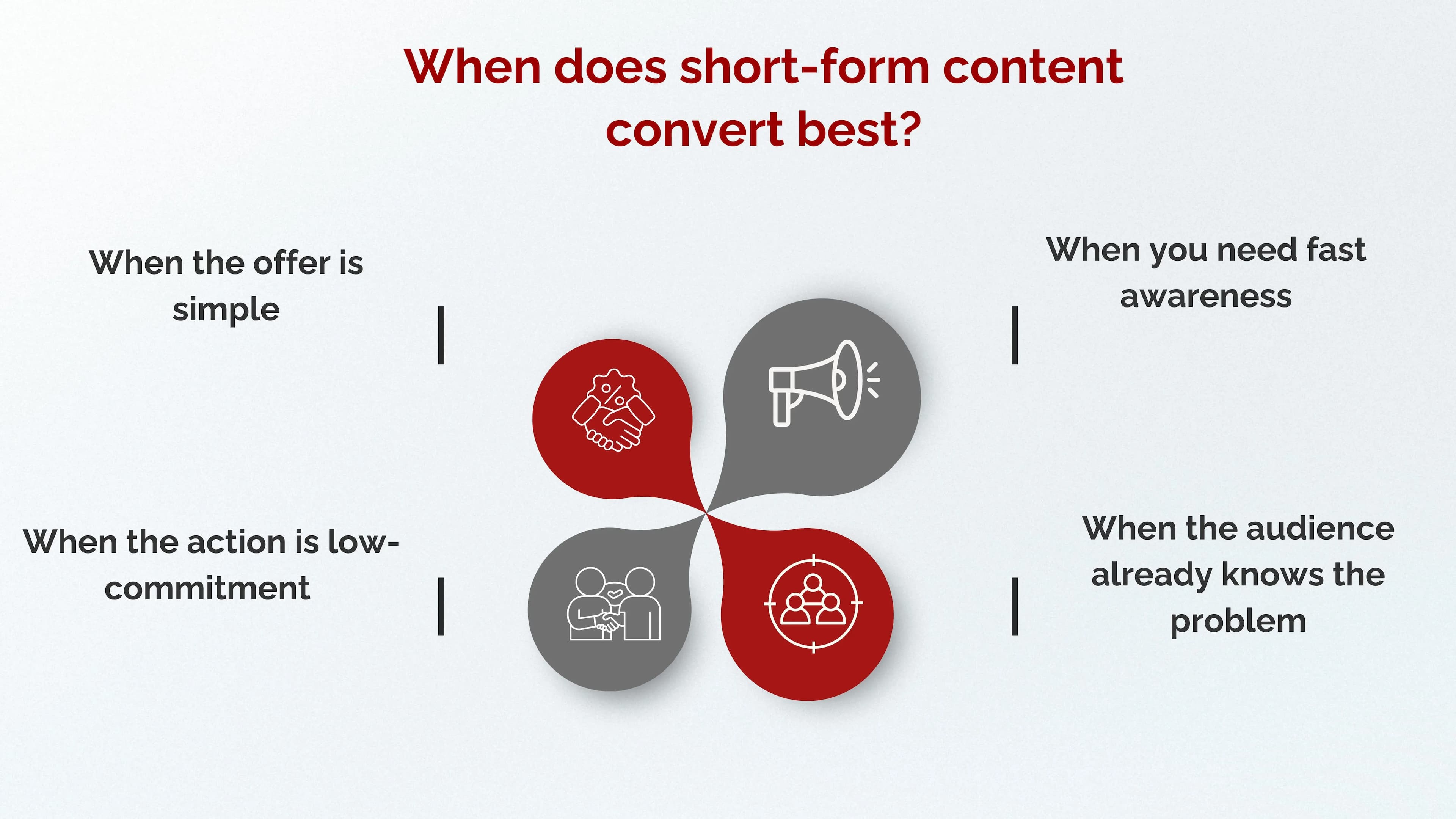
Conversion advantages of short-form
Short-form can outperform long-form when we need:
-
Fast demand generation Social posts and short videos can create a spike of interest quickly.
-
High volume testing We can test hooks, pain points, and offers faster than with long-form.
-
Retargeting fuel Short-form ads and posts can remind people of a decision they’re already leaning toward.
-
Micro-conversions Saves, shares, DMs, click-throughs, these build the path to a sale.
Short-form is less about “explaining everything” and more about “making the next step obvious.”
The Real Answer: Conversions happen across a journey, not a single post
If we’re honest, most conversions don’t come from one piece of content. They come from a chain:
- A short post sparks interest
- A long-form guide builds trust
- An email or landing page closes
- A case study removes final doubt
So instead of choosing between long and short, we should build a system where they support each other.
Which converts better at each stage of the funnel?
Here’s the simplest way to think about it:
Top-of-funnel (attention + awareness)
Short-form content usually wins.
- Quick hooks
- Clear pain points
- Easy consumption
Examples:
- 30–60 second video
- Instagram carousel
- LinkedIn post
- Short newsletter insight
Goal: get the click, follow, signup, or interest signal.
Middle-of-funnel (education + evaluation)
Long form content usually wins.
- comparisons
- frameworks
- “how it works”
- objection handling
Examples:
- long blog posts
- guides
- webinars
- pillar pages
Goal: build certainty and preference.
Bottom-of-funnel (decision + purchase)
It depends, but often:
- long-form pages (pricing explainers, case studies) for high-consideration offers
- short-form CTAs (limited-time offer, testimonial clip) for quick nudges
Goal: remove final friction and make “yes” easy.
SEO vs social: format matters based on channel
A big part of your content marketing strategy should choosing the right format for the right channel.
Google and SEO
Search users want completeness. They’re literally asking for information.
That’s why long form content tends to win for:
- “how to”
- “best tools”
- “X vs Y”
- “pricing”
- “process”
With strong seo copywriting, long-form can bring consistent traffic month after month.
Social platforms
Social users want speed and relevance.
That’s why short form content tends to win for:
- trends
- quick tips
- opinions
- punchy case study results
- behind-the-scenes credibility
But here’s the key: short-form can still support SEO by driving branded searches and links indirectly.
So what should we choose? Use this decision checklist
If you're deciding what to create next, use these questions:
Go long-form if:
- the topic has search demand and ranking potential
- the buyer needs education to convert
- the decision is expensive or high-stakes
- we need evergreen traffic
Go short-form if:
- we need quick visibility or testing
- we want to generate leads through social or email
- the offer is simple and clear
- we’re supporting retargeting and reminders
Better yet: combine them intentionally
A smart content plan often looks like this:
- 1 long-form pillar piece per week (or biweekly depending on resources)
- 3–7 short-form pieces sliced from it for social/email
- 1 conversion asset (case study, landing page, newsletter sequence)
That’s how we get both sustained SEO growth and fast distribution.
Common conversion mistakes (and how to avoid them)
Mistake 1: Writing long content that says nothing
Long-form doesn’t convert just because it’s long. It converts because it’s useful.
Fix it by:
- matching search intent
- adding examples, steps, and proof
- removing fluff intros
Mistake 2: Using short-form with no next step
Short-form needs a clear next action.
Fix it by always including one:
- “Get the checklist”
- “Read the full guide”
- “Book a call”
- “Reply ‘X’ and we’ll send it”
Mistake 3: Treating SEO like a writing style
SEO is structure plus intent, not keyword stuffing.
Strong seo copywriting means:
- clear headings
- direct answers
- topic coverage
- natural keyword use
- internal links
Mistake 4: Not tracking the right conversion metric
Don’t judge content performance only by views or impressions.
Track:
- email signups
- demo bookings
- assisted conversions
- time-to-lead
- qualified lead rate
Want content that actually converts?
If you’re tired of publishing content that gets attention but doesnt drive revenue, we can help. At Seven Koncepts, we build a conversion-focused content marketing strategy that connects short form content and long form content into a system, supported by SEO, clear CTAs, and messaging that fits your audience.
Reach out to Seven Koncepts and we’ll help you build a content plan that drives real conversions.
FAQs
1. Does long-form content convert better than short-form content?
Long-form converts better when trust and education matter (higher-priced or more complex offers). Short-form converts better for quick actions and early-stage engagement.
2. Is short-form content bad for SEO?
Not necessarily. Short-form can support SEO indirectly by driving brand awareness, clicks, and branded searches. But most competitive SEO topics still favor deeper pages.
3. What’s the best content length for conversions?
There isn’t one perfect length. The best length is what fully answers the question and moves the reader to the next step without filler.
4. How do we decide what to publish first?
Start with content tied to real conversion intent: comparisons, pricing explainers, “best for” pages, and problem-solution topics. Then repurpose into short-form.
5. How does seo copywriting help conversions?
Good seo copywriting matches search intent, uses clear structure, and makes it easy for readers to act, helping pages rank and convert at the same time.
6. What should a content plan include?
A content plan should include topics, target keywords, publishing cadence, content formats, distribution channels, internal linking, and the CTA for each piece.