
In the fast-paced world of digital marketing, one question dominates: Are our efforts truly paying off? If you're spending your hard-earned budget on Google Ads or other marketing tactics, you want to be sure that the results are worth it. That's where performance metrics come in - the numbers that show whether your campaigns are actually delivering a meaningful Return on Investment (ROI). However, not all metrics are created equal.
In this blog, we’ll dive into the performance metrics that matter most when measuring ROI and how they can help you optimize your strategy. That’s where performance metrics come in - the numbers that show whether your campaigns are actually delivering a meaningful Return on Investment (ROI).
Why Performance Metrics Matter
Before diving into specifics, let’s quickly establish why performance metrics are crucial for ROI. Metrics provide data-driven insights into how well your campaigns are performing. Without tracking these numbers, you’re essentially flying blind, hoping your marketing is bringing in profits.
Performance metrics help digital marketers like you monitor the effectiveness of their campaigns, understand customer behavior, and make informed decisions that ultimately lead to higher ROI. Whether you're partnering with a digital marketing agency, or managing campaigns in-house, tracking the right metrics is the only way to measure true success.
Essential Performance Metrics to Track for ROI
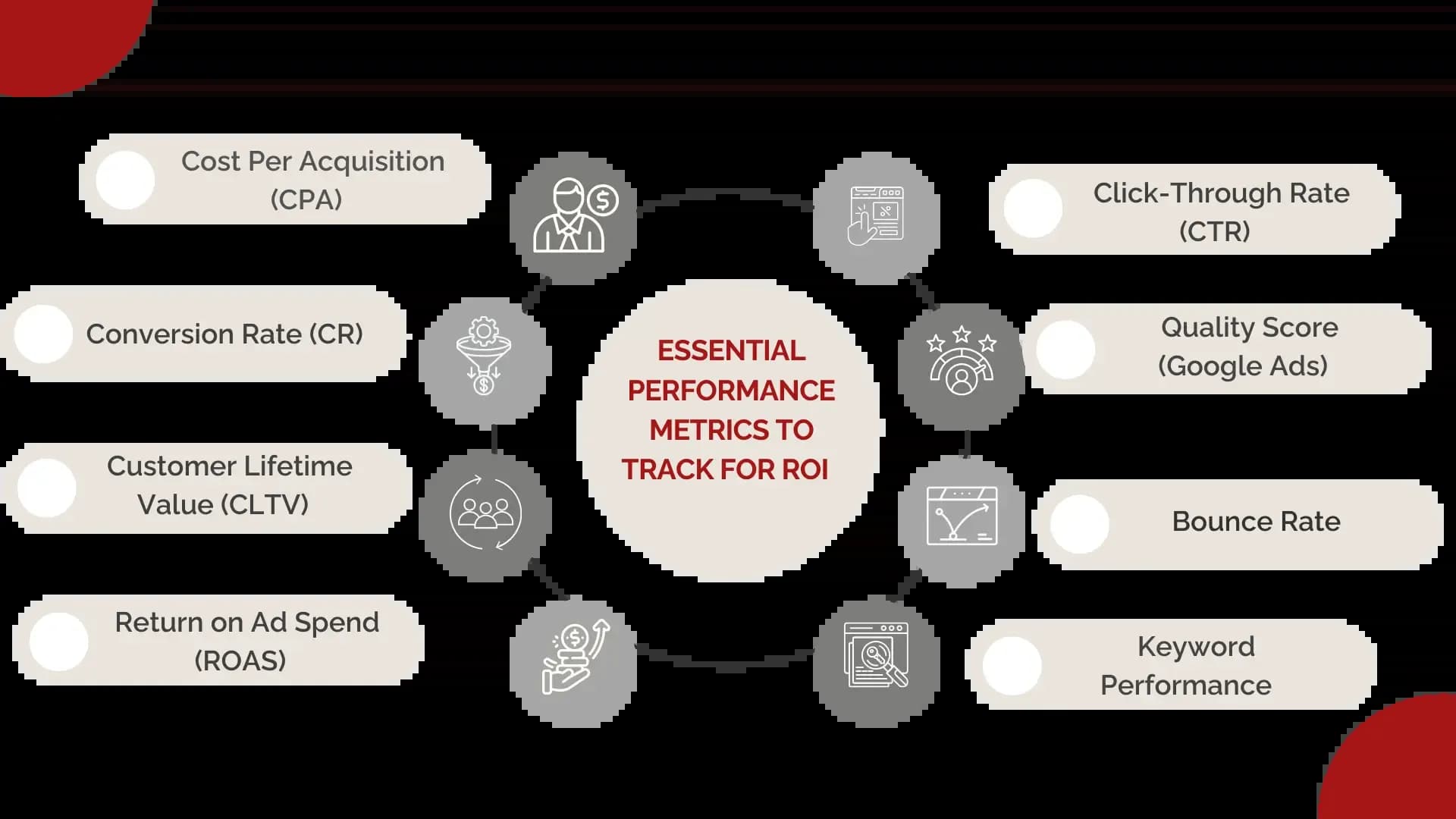
Not all metrics indicate success. While vanity metrics might look good on paper, they don’t always translate to ROI. To truly understand how your digital marketing efforts are impacting your bottom line, you need to track the right KPIs. Here’s a rundown of the most important metrics to focus on:
1. Cost Per Acquisition (CPA)
If you're working with Google Ads experts or any digital agency, you’ve likely heard about CPA. CPA measures the cost of acquiring a new customer through your campaign.
-
How to use it: Divide your total campaign cost by the number of customers acquired. For example, if you spent $1,000 on Google Ads and gained 50 new customers, your CPA is $20.
-
Why it matters: This metric reveaks how cost-efficient your campaigns are. A lower CPA means you’re spending less to acquire each customer, thus improving your ROI.
2. Conversion Rate (CR)
Conversion rate is a fundamental metric that directly impacts ROI. It tells you the percentage of visitors who take a desired action on your site, such as signing up for a newsletter, making a purchase, or downloading a white paper.
-
How to use it: Calculate the percentage of people who complete the desired action divided by the total number of visitors. For example, if 100 people visit your landing page and 10 make a purchase, your conversion rate is 10%.
-
Why it matters: A higher conversion rate means your website or ad is effectively guiding users to take action. By improving your conversion rate, you can boost ROI without increasing your marketing spend.
Tip: Even small improvements in conversion rate can significantly boost your ROI without increasing ad spend.
3. Customer Lifetime Value (CLTV)
CLTV estimates the total revenue a customer will generate throughout their relationship with your brand. It’s an important metric for measuring the long-term ROI of customer acquisition strategies.
-
How to use it: Multiply the average purchase value by the average number of purchases over the customer’s lifetime.
-
Why it matters: A high CLTV indicates loyal, repeat, customers - the most reliable path to sustainable ROI growth.
4. Return on Ad Spend (ROAS)
ROAS is one of the clearest indicators of whether your ad spend is actually paying off. It compares the revenue generated by your campaigns to the amount spent.
-
How to use it: Simply divide the revenue generated by your ads by the cost of the ads. For example, if you made $3,000 in sales and spent $1,000 on ads, your ROAS is 3:1.
-
Why it matters: A high ROAS indicates that your advertising efforts are delivering strong ROI, while a low ROAS suggests you might need to optimize your campaigns.
5. Click-Through Rate (CTR)
CTR measures how often people click on your ads after seeing them. It's a good indicator of how well your keywords and ad copy are resonating with your target audience.
-
How to use it: Divide the number of clicks by the number of impressions, then multiply by 100 to get a percentage.
-
Why it matters: A higher CTR generally indicates that your ads are relevant and engaging. By improving your CTR, you can drive more traffic to your website, which can lead to increased conversions and ultimately higher ROI.
6. Quality Score (Google Ads)
When you run Google Ads, your ads are scored based on relevance and quality. This score impacts how much you pay per click and your ad's position.
-
How to use it: Google calculates Quality Score based on several factors, including CTR, ad relevance, and landing page experience.
-
Why it matters: Higher Quality Scores lead to lower costs and better ad positioning, improving ROI. Using tools like Google Keyword Planner helps you target high-performing keywords that strengthen your Quality Score - and reduce your overall cost per click (CPC) .
7. Bounce Rate
The bounce rate tells you the percentage of visitors who leave your website after viewing only one page. A high bounce rate signals that visitors aren’t finding what they expected - or that your content isn’t keeping them engaged.
-
How to use it: Use Google Analytics to track your bounce rate. Aim for a bounce rate lower than 40-50% for most websites.
-
Why it matters: A high bounce rate means your landing page or content isn’t capturing your visitors’ attention, which can negatively impact conversions and ROI. Lowering your bounce rate through better design, content, and user experience can directly improve ROI.
8. Keyword Performance
Keywords are the foundation of any digital marketing campaign, whether you're using SEO or Google Ads. Analyzing the performance of the keywords you're targeting can provide critical insights into your ROI.
-
How to use it: Use a keyword tool like Google Keyword Planner to track keyword performance. Are certain keywords driving traffic but not conversions? Or are some keywords bringing in high-quality leads that convert?
-
Why it matters: By focusing on high-performing, intent-driven keywords you attract visitors who are more likely to convert - directly increasing ROI.
How to Optimize Your Digital Marketing ROI
Now that you know which metrics to track, let’s discuss a few ways you can use them to optimize your digital marketing campaigns:
-
Focus on High-Performing Channels: Not all marketing channels contributes equally. If you’re working with a digital marketing company, you can use performance metrics to identify which channels are driving the most revenue and allocate more budget toward those.
-
Continuous A/B Testing: Regularly test your ads, landing pages, and even your keyword selection. Use your performance metrics to identify areas for improvement and fine-tune your campaigns.
-
Adjust Based on Data: Don’t let your campaigns run on autopilot. Use real-time data to adjust your strategies. If certain keywords are driving high conversion rates, focus on those. If a campaign has a high CPA, consider tweaking your approach.
-
Leverage Retargeting: Retarget visitors who didn't convert the first time. By focusing on people who’ve already shown interest, you can often see a higher ROI.
Conclusion
In the ever-evolving world of digital marketing, tracking the right performance metrics is crucial for understanding the impact of your efforts. By focusing on key indicators like conversion rates, cost per acquisition, and return on ad spend, you can gain a clear picture of what's driving value and what needs improvement.
Ultimately, these metrics help you make data-driven decisions that optimize your campaigns, ensuring that every dollar spent works harder for your business. By continuously refining your strategy and staying attuned to your performance data, you'll be able to maximize your ROI and drive long-term success.
At Seven Koncepts, we specialise in helping businesses unlock the full potential of their digital marketing ROI. Whether it’s through targeted keyword research or refining your performance metrics, our team of experts can help you boost ROI and drive sustainable growth.
FAQs
1: What are the most important performance metrics for digital marketing?
The most important performance metrics for digital marketing include Cost Per Acquisition (CPA), Conversion Rate (CR), Customer Lifetime Value (CLTV), and Return on Ad Spend (ROAS).
2: How can I improve my digital marketing ROI?
To improve ROI, focus on high-performing channels, test ads and keywords regularly, and continuously optimize based on data insights.
3: What role does keyword research play in performance metrics?
Effective keyword research ensures you’re targeting high-converting search terms. By optimizing for the right keywords, you can improve CTR, conversion rates, and ultimately, ROI.
4: How often should I analyze my performance metrics?
Regular analysis is essential. Consider reviewing your performance metrics at least weekly to ensure you're on track and can make timely adjustments.