
Artificial intelligence is reshaping industries at an unprecedented pace . From automated content generation to predictive analytics and design tools, AI is now embedded in how businesses operate. But as automation expands, one question becomes more important than ever: where does human creativity stand in an AI-driven industry?
At Seven Koncepts, we believe the future does not belong to AI alone. It belongs to those who understand how to combine AI efficiency with human creativity. Technology can accelerate processes, but creativity remains deeply human.
In this blog, we explore why human creativity still matters, how it complements AI, and how businesses can strike the right balance between automation and originality.
The Rise of AI in Modern Industries
AI has moved beyond experimentation. It now powers:
- Content generation tools
- Marketing automation platforms
- Data analysis systems
- Design assistance software
- Chatbots and customer engagement tools
Businesses are adopting AI because it saves time, reduces manual effort, and increases scalability. Tasks that once took weeks can now be completed in hours. However, efficiency is not the same as originality, and speed does not automatically translate into meaningful connection. That is where human creativity becomes essential.
The Balance Between Automation and Originality
Automation brings structure and predictability. Creativity brings emotion and differentiation.
AI excels at:
- Processing large volumes of data
- Recognizing patterns
- Generating variations quickly
- Optimizing based on measurable performance
Humans excel at:
- Understanding nuance
- Interpreting context
- Expressing emotion
- Creating stories that resonate
The most successful brands today are not choosing one over the other. They are integrating both.
At Seven Koncepts, we approach AI as an amplifier, not a replacement. Automation supports efficiency, but originality defines identity.
Why AI Cannot Replace Creative Intuition
AI works by learning from existing data. It predicts, replicates, and rearranges patterns based on what already exists.
Creative intuition, however, is different.
It is shaped by:
- Lived experience
- Cultural awareness
- Emotional intelligence
- Risk-taking
- Vision
AI can suggest designs. It cannot feel the emotional weight of a message. AI can generate content, butIt cannot truly understand the human condition.
When building brands, launching products, or telling stories, intuition often guides decisions that data alone cannot explain. Sometimes the boldest ideas are not the safest ones. They are not derived from trends but from insight.
That instinct remains uniquely human.
Human-Led Storytelling as a Competitive Advantage
In an AI-saturated market, originality becomes rare,and rarity creates value.
Consumers can recognize formulaic messaging. When everything begins to sound similar, brands that tell authentic stories stand out.
Human-led storytelling allows brands to:
- Communicate purpose, not just features
- Build emotional connections
- Reflect real-world experiences
- Adapt tone with sensitivity
- Express a unique voice
At Seven Koncepts, we see storytelling as strategy, not decoration. AI may help refine messaging, but the narrative direction must come from people who understand the audience beyond numbers.
The Risk of Over-Automation
Relying entirely on automation carries risks.
- Generic content that lacks depth
- Over-optimized messaging that feels mechanical
- Brand voice inconsistency
- Reduced authenticity
- Audience disengagement
While AI increases output, it does not automatically improve impact.
Creativity requires judgment. Judgment requires human oversight.
Businesses that use AI without human direction risk blending into a sea of similar content.
How to Combine AI and Human Creativity Effectively
The real opportunity lies in integration. Instead of asking whether AI should replace creativity, the better question is how both can work together.
Here are practical strategies.
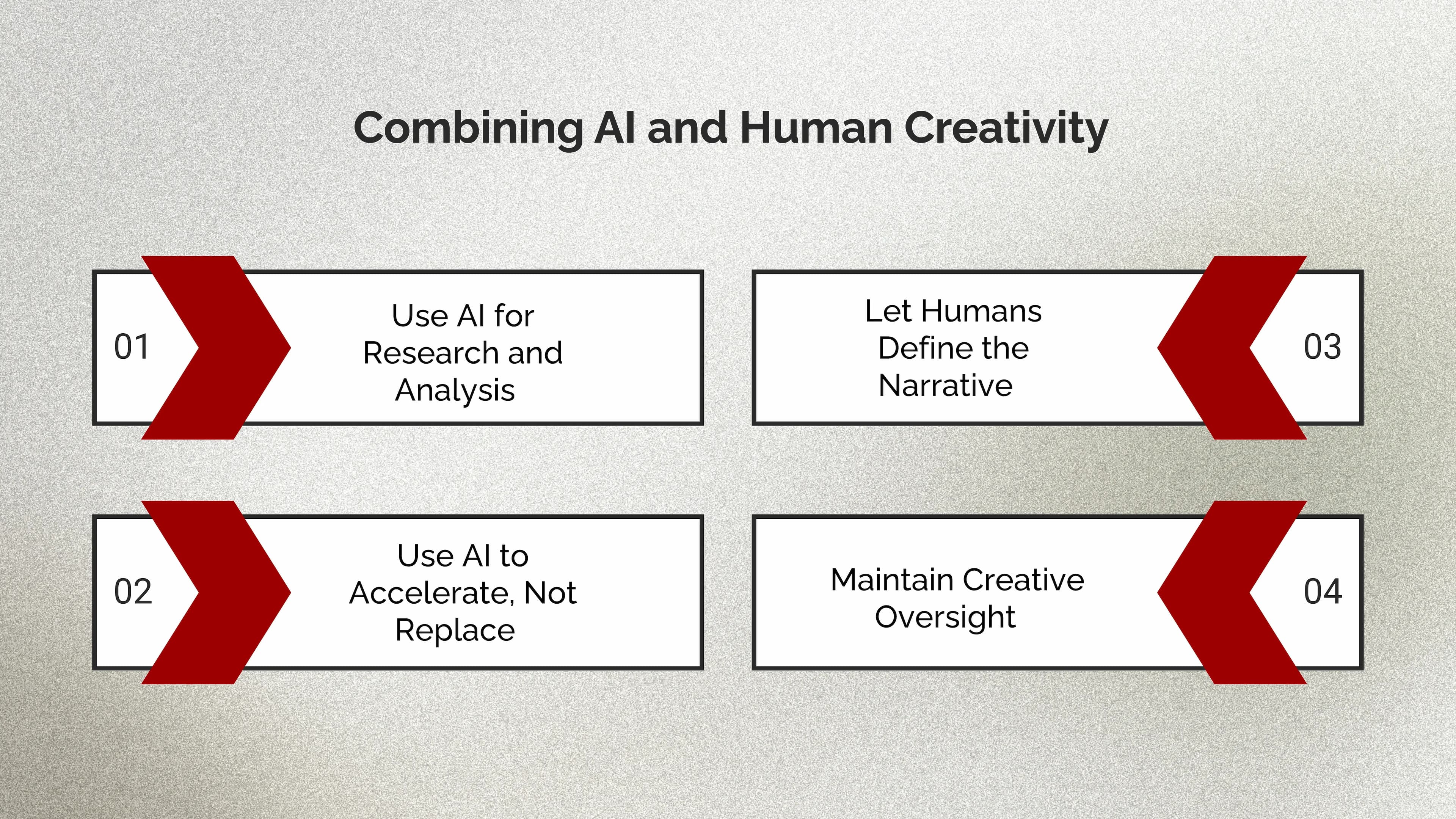
1. Use AI for Research and Analysis
AI can process market trends, audience behavior, and competitor data faster than any human team.
Use AI to:
- Identify content gaps
- Analyze search intent
- Predict engagement trends
- Suggest data-backed improvements
Then allow creative teams to interpret those insights with strategic judgment.
2. Let Humans Define the Narrative
AI can generate drafts, but it should not define the story.
Humans should:
- Set the brand tone
- Craft emotional messaging
- Decide positioning
- Build long-term creative direction
AI can refine. Humans should lead.
3. Use AI to Accelerate, Not Replace
Automation works best when it removes repetitive tasks.
For example:
- Draft structuring
- Grammar refinement
- Content optimization
- Data visualization
This frees human creatives to focus on big-picture thinking.
4. Maintain Creative Oversight
Every AI-generated output should be reviewed and approved by a human.
This ensures:
- Alignment with brand voice
- Contextual accuracy
- Ethical responsibility
- Quality control
At Seven Koncepts, we treat AI as a collaborator, but final decisions always remain human-led.
The Future Belongs to Hybrid Thinkers
Industries are evolving. Creative professionals who ignore AI risk falling behind. But businesses that depend solely on automation risk losing identity.
The future belongs to hybrid thinkers. Teams that understand:
- Technology
- Strategy
- Storytelling
- User psychology
- Brand architecture
AI expands capability. Human creativity defines direction.
Creativity as a Long-Term Differentiator
Technology will continue to advance. Tools will become smarter. Automation will become more accessible.
But originality will always remain scarce.
Brands that invest in creative thinking will:
- Build stronger loyalty
- Maintain authentic communication
- Adapt faster to change
- Create memorable experiences
In an AI-driven industry, creativity is no longer optional. It is a strategic advantage.
What This Means for Modern Businesses
If you are building a brand, launching a product, or scaling digitally, ask yourself:
- Are we using AI efficiently?
- Are we protecting our brand voice?
- Are we prioritizing originality?
- Are we blending automation with human judgment?
The goal is not to compete with AI. The goal is to use it intelligently while preserving what makes your brand human.
The Seven Koncepts Approach
At Seven Koncepts, we do not view AI as a shortcut. We see it as a tool that supports creativity, strategy, and innovation. Our approach blends intelligent automation with human insight to build brands that are both efficient and authentic.
We believe the strongest digital solutions are those where technology works in the background while human creativity leads.
Ready to Build With Intelligence and Creativity?
If you want to harness AI without losing your brand’s originality, Seven Koncepts can help. We combine strategic thinking, creative storytelling, and intelligent automation to deliver solutions that are scalable, impactful, and uniquely yours.
Partner with Seven Koncepts and build for the future without sacrificing what makes your brand human.
FAQs
1. Can AI fully replace creative professionals?
No. AI can assist and accelerate tasks, but it cannot replicate human intuition, emotional intelligence, or lived experience.
2. Is using AI in creative industries risky?
It depends on how it is used. AI becomes risky when it replaces strategic thinking rather than supporting it.
3. How can businesses maintain authenticity while using AI?
By keeping human oversight at every stage. AI should enhance workflows, but final creative direction must remain human-led.
4. Is AI necessary for modern businesses?
AI is not mandatory, but it offers efficiency and scalability advantages. The key is integrating it thoughtfully rather than relying on it blindly.