
Let’s get one thing straight: AI isn’t coming for designers’ jobs. It’s coming to help them design better, faster, and smarter. The fear that generative AI will replace creative professionals is understandable, but here’s the truth: design isn’t just about creating visuals; it’s about emotion, storytelling, and human intuition. And that’s something AI can’t replicate.
Instead of viewing AI as competition, it’s time to see it as a co-creator, a tool that enhances creativity rather than erases it. In this new era, the best work happens when human imagination and machine intelligence collaborate.
What Exactly Is Generative AI in Design?
Before we talk about collaboration, let’s make sure we’re on the same page about what Generative AI actually means.
Generative AI refers to artificial intelligence systems that can create content- text, images, videos, designs, and even music - based on the prompts or data you give them. In the design world, these tools can generate ideas, mock-ups, colour palettes, layouts, or even finished visuals within seconds.
Some popular examples you might’ve heard of include:
- Midjourney artificial intelligence – for generating detailed, imaginative visuals.
- DALL·E 3 – for creating AI-generated artwork based on text prompts.
- Adobe Firefly – integrated into Adobe tools to help designers edit or create with AI.
- Figma AI & Canva Magic Studio – for quick layouts, design variations, and content ideas.
These tools don’t “replace” the designer, they give designers a superpower: the ability to generate more ideas, test more concepts, and push creative boundaries faster than ever before.
Why Designers Fear AI and Why They Shouldn’t
Many designers worry that AI-generated visuals will make human designers unnecessary. But if you think about it, we’ve faced this fear before.
- When Photoshop arrived, people thought traditional artists were finished.
- When Canva became popular, professional designers thought clients would stop hiring them.
- But guess what? Each new technology has expanded creativity instead of shrinking it.
Generative AI is just the next chapter in that story. It doesn’t eliminate creativity, it democratizes it.
The difference now is that designers can use AI to:
- Automate repetitive or time-consuming tasks.
- Brainstorm faster and visualize abstract ideas instantly.
- Explore multiple design directions before choosing the final one.
- Collaborate with clients and teams in real-time with more clarity and precision.
AI as a Co-Creator: What It Actually Looks Like
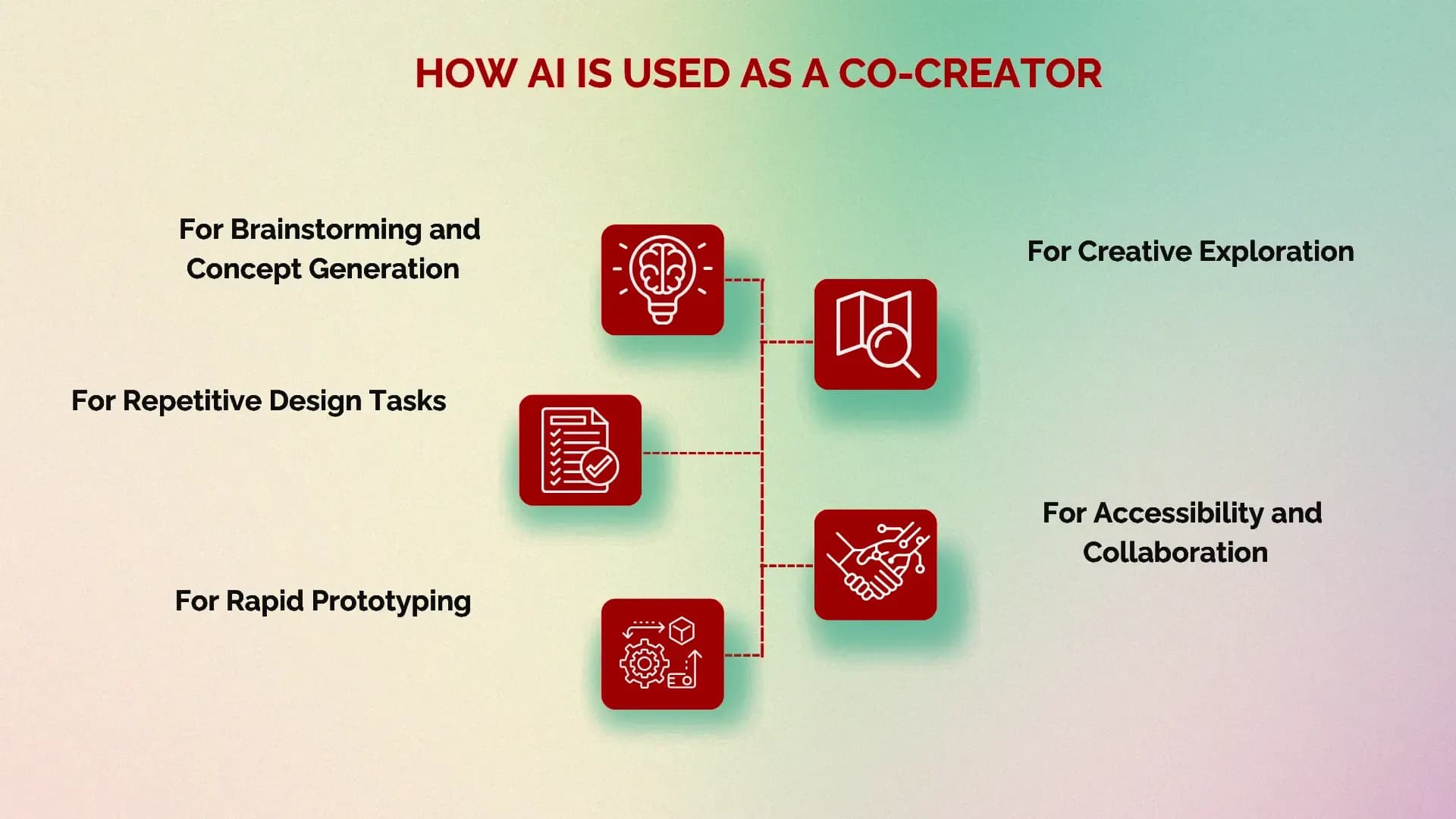
Think of AI as your creative partner, the one that never gets tired, never runs out of ideas, and never judges your rough drafts.
Here’s how designers are using generative AI as a co-creator today:
1. For Brainstorming and Concept Generation
Coming up with new ideas can be the hardest part of design. AI can generate dozens of mood boards or concepts based on your prompt in seconds.
Example: You type, “Futuristic brand identity for a sustainable fashion label,” and within moments you get multiple visual directions to build on.
You still make the final call, AI just helps you see more options, faster.
2. For Repetitive Design Tasks
Every designer knows how time-consuming it can be to resize images, adjust layouts, or create small variations of the same design.
Generative AI can automate those repetitive steps, giving you more time to focus on high value creative thinking.
3. For Rapid Prototyping
Instead of spending hours building mockups from scratch, you can use AI to visualize ideas in real-time. You can quickly generate multiple website or app interface concepts, then refine the best one manually.
4. For Creative Exploration
Sometimes, AI suggests something you wouldn’t have thought of, a new texture, layout, or visual direction. It can inspire you to take your ideas further, much like a creative brainstorming partner.
5. For Accessibility and Collaboration
AI tools like Canva and Adobe Firefly make design accessible for non-designers too, allowing teams to collaborate better. Designers can stay focused on strategy, systems and big ideas while others handle smaller edits.
The Boundaries of AI and the Power of Human Creativity
AI can generate. But it doesn’t understand.
It doesn’t feel joy, sorrow, excitement, or purpose and that emotional layer is the heart of good design.
A great designer knows how to capture emotion, connect with audiences, and tell stories that matter. That’s something no algorithm can truly replicate.
Here’s what human designers bring that AI never will:
- Empathy: Understanding the client’s vision and user’s emotion.
- Context: Knowing why something works, not just how it looks.
- Taste: Making artistic decisions that feel authentic, not mechanical.
- Meaning: Creating designs that carry personality and brand identity.
So yes, AI can help generate an image or layout but only a human can make it resonate.
Designers and AI: The Perfect Creative Duo
When designers embrace AI, they’re not giving up control; they’re taking command of a more powerful toolkit.
Here’s what that partnership looks like in action:
- AI is the idea Generator Human is the storyteller who refines the vision.
- AI = Speed and Efficiency Human = Creativity and Emotion.
- AI = Data and Algorithms Human = Strategy and Insight.
Together, they create designs that are not just beautiful, but also intelligent, scalable, and deeply human.
Real-World Examples of AI and Human Collaboration in Design
Let’s take a look at how this plays out in real brands and creative projects:
-
Adobe and Firefly: Adobe’s AI isn’t there to replace designers; it’s built for them. Firefly helps with background removal, color matching, or image expansion, while designers still lead the creative direction.
-
Coca-Cola’s “Create Real Magic” Campaign: The brand used AI tools like ChatGPT and DALL·E to let fans create artwork, blending human creativity with machine assistance.
-
Design agencies now use AI tools to generate rough layouts before refining them manually, saving hours while maintaining originality.
These examples show one thing clearly: when humans and AI collaborate, creativity multiplies.
How to Embrace AI as a Designer
If you’re a designer or a creative professional, now’s the time to start exploring AI, not fearing it.
Here’s how to integrate it into your workflow effectively:
1. Learn the Tools
Start with tools like Midjourney, Adobe Firefly, or Canva Magic Studio. Experiment with prompts and observe what kind of results you get.
2. Master Prompt Engineering
The better your prompt, the better the result. Learn how to describe your ideas clearly so AI can bring them to life.
3. Use AI for Brainstorming, Not Final Designs
AI can give you inspiration but your final design should always have your creative fingerprint.
4. Keep Your Human Touch
Always infuse storytelling, context, and strategy into your work. AI handles execution; you handle emotion.
5. Stay Curious
AI is evolving fast. The designers who stay curious and adaptable will stay ahead of the game.
The Future: Designers as Creative Directors of AI
The future of design isn’t about who can draw better, it’s about who can collaborate better with technology.
Designers will increasingly act as creative directors for AI, guiding, curating, and refining outputs rather than manually producing every element.
AI will handle the heavy lifting, while humans define the vision, message, and emotional impact. So rather than fearing AI, the goal should be to lead it, to use it as an extension of your creativity.
Conclusion: Collaboration Over Competition
Generative AI isn’t your rival. It’s your teammate. It doesn’t steal your creativity, it amplifies it.
The future of design is co-creation, a world where humans and AI build together, each contributing what they do best. The designer brings meaning, empathy, and strategy; AI brings speed, precision, and infinite ideas.
If you learn how to blend the two, your creativity won’t just survive, it’ll thrive.
Create the Future of Design with Seven Koncepts
At Seven Koncepts, we believe creativity and technology aren’t opposites; they’re partners. Our design and digital marketing teams use AI-powered tools alongside human imagination to create campaigns that inspire, engage, and convert.
Ready to build your next big idea with human creativity and AI innovation?
Let’s collaborate and design smarter, together. Visit Seven Koncepts today and start your journey toward the future of intelligent design.