
Blending paid and organic marketing isn’t just a “nice-to-have” anymore. It’s one of the strongest ways to build visibility, attract consistent traffic, and scale your brand sustainably. In a digital world where algorithms shift daily and competition gets tougher by the minute, relying solely on organic or solely on paid will slow your growth. But when these two forces work together? That’s when brands unlock real momentum. Here’s exactly how we and you can do that.
Why Combining Organic & Paid Marketing Simply Makes Sense
Most businesses view organic and paid as two separate worlds. Organic is the “long game,” while paid is the “fast track.” But the truth is, both sides fuel each other. Here’s why blending them is powerful:
-
Organic builds trust. When people find you naturally through SEO, blogs, and social content, they see you as credible.
-
Paid fuels visibility. With platforms becoming more competitive, paid ads (especially Google pay per click ads) give you immediate traffic.
-
Both create data synergy. What works in paid can sharpen your SEO. What works in SEO can be amplified through PPC strategy.
Your audience sees you everywhere - which boosts recall, trust, and conversions. At Seven Koncepts, we’ve seen first-hand how brands grow significantly faster when SEO and PPC strategies work hand-in-hand, not independently.
The Core Advantage of a Paid + Organic Blend
When we talk about blending strategies, we’re talking about integrating:
- SEO (organic)
- PPC (paid)
- Content marketing
- Social media (organic + paid)
- Email nurturing
This mix- especially SEO and PPC marketing helps brands balance short-term wins with long-term stability.
Paid drives quick wins.
If you want leads today, Google search PPC is the fastest route. A strong ppc strategy puts you in front of people already searching for your solution.
Organic keeps traffic coming.
SEO builds momentum over time, lowering your cost per conversion and increasing your authority.
And when both feed into each other? You get:
- More visibility
- Higher click-through rates
- Better-quality leads
- Lower advertising cost over time
How to Blend Paid & Organic for Maximum Reach
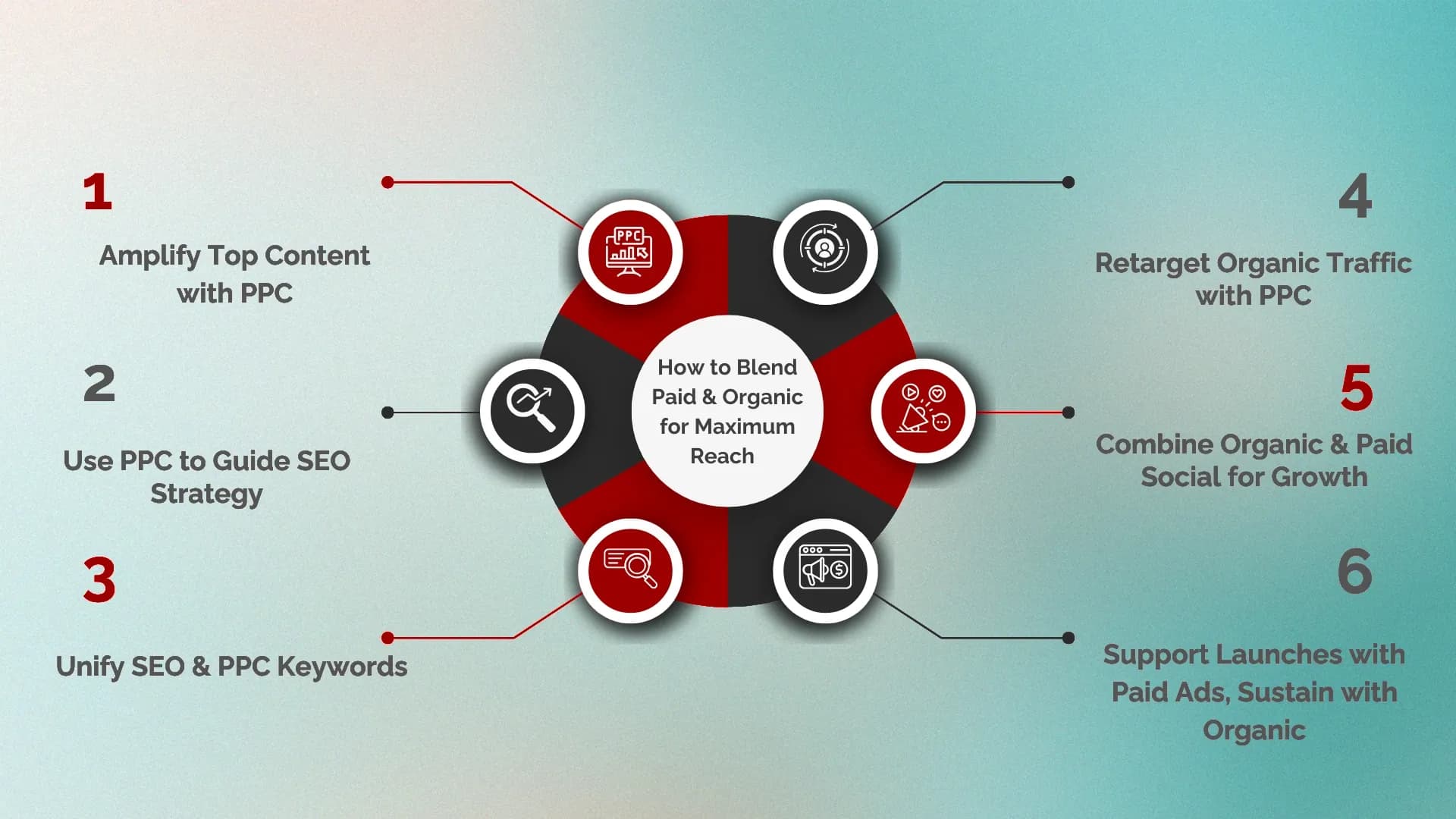 Below are practical methods we use every day when working with brands that want sustainable, scalable growth.
1. Use PPC to Amplify High-Performing Organic Content
Your SEO-driven blogs or landing pages are already attracting visitors! Great. Now imagine doubling or tripling that traffic by promoting your best-performing pieces through targeted Google pay per click ads.
Why this works:
- Organic shows the content is relevant
- PPC guarantees it gets in front of a larger audience
- This combo boosts engagement and helps content rank longer
Examples of content worth amplifying:
- How-to guides
- Industry reports
- Case studies
- Lead magnets
- Top-ranking blogs
This is one of the most efficient ways to merge SEO and PPC strategies without blowing your budget.
2. Let PPC Testing Guide Your Organic Strategy
Paid campaigns give instant data. Organic usually takes months to clearly show what’s working.
Instead of guessing which content or keywords your audience wants, use PPC to test:
- Headlines
- Ad copy
- Target keywords
- Landing page layouts
- Value propositions
Once you see which messages convert best, integrate them into your SEO copy, blogs, and website structure. This is a major unlock for brands looking to strengthen both SEO & PPC.
3. Build a Unified Keyword Strategy (SEO + PPC)
One mistake many brands make is running separate keyword lists for SEO and PPC. But when these two align, your visibility multiplies.
Here’s how we recommend blending them:
For SEO:
- Prioritize long-tail, informative keywords
- Target high-intent search queries
- Build authority with evergreen content
For PPC:
- Target competitive keywords that are harder to rank for
- Focus on commercial intent queries
- Drive traffic to high-converting landing pages
This balanced search engine marketing PPC approach ensures you appear in both paid and organic real estate- double the exposure, double the trust.
4. Retarget Organic Visitors Using PPC
People who find you through SEO are valuable because they’re actively searching for what you offer. But not everyone converts on their first visit.
That’s where PPC retargeting shines.
With Google search PPC and display retargeting, you can re-engage:
- Blog readers
- Website visitors
- Product page viewers
- Form abandoners
These users already know you, so ads tend to convert at a higher rate. This is one of the most effective ways to blend SEO, PPC and paid campaigns into a single high-performing funnel.
5. Use Organic Social to Build Trust, Paid Social to Scale
Organic social content humanizes your brand. Paid social ads accelerate your reach.
Here’s how we combine them:
Organic social does the nurturing:
- Behind-the-scenes
- Educational posts
- User-generated content
- Community engagement
Paid social does the scaling:
- Boosting your best posts
- Promoting offers or webinars
- Driving leads
- Retargeting warm audiences
This dual approach builds both community and conversion power.
6. Use Paid Ads to Support New Launches and Organic to Sustain Them
Whenever you launch:
- a new product
- a new service
- a new campaign
Paid ads create immediate buzz.
Organic content then sustains momentum by:
- ranking for relevant keywords
- attracting recurring visitors
- building long-term credibility
You shouldn’t expect new content to rank immediately, that’s where a strong PPC strategy fills the gap.
What a Full Paid + Organic Funnel Looks Like
Here’s a simple example of how the integration flows:
- Step 1: SEO content brings in visitors
- Step 2: Social sharing increases organic reach
- Step 3: PPC ads boost top-performing content
- Step 4: Retargeting warms up visitors ready to buy
- Step 5: PPC insights shape future SEO content
- Step 6: Organic rankings grow and reduce PPC cost over time
This loop is what creates long-term digital growth that compounds month after month.
Best Practices for Blending SEO & PPC
If you’re ready to implement this approach, here are some actionable tips:
- Use shared reporting dashboards to evaluate both efforts
- Sync keyword lists between SEO and PPC teams
- Align messaging across landing pages, ads, and blogs
- Use PPC to test meta titles, CTAs, and headlines
- Track user behavior after both organic and paid clicks
- Leverage audience insights to create targeted content
The more aligned your SEO and PPC marketing become, the faster your visibility and conversions grow.
Final Thoughts: Why the Blend Matters
We live in a digital world where no single channel guarantees visibility. Google’s landscape is competitive. Social media algorithms fluctuate. Audience behavior changes.
But one thing stays consistent:
When paid and organic efforts work together, brands grow stronger, faster, and more sustainably.
At Seven Koncepts, we believe in building compound growth, not just quick spikes. That’s why we love helping brands integrate search engine marketing PPC techniques with long-term SEO strategies to create marketing ecosystems that never stop performing.
Ready to Scale Your Brand with a Blended Strategy?
If you want help building a powerful, unified SEO + PPC system that actually drives results, we’d love to support you.
Reach out to Seven Koncepts today and let’s build a strategy that grows with you!
FAQs
1. Why is combining SEO and PPC more effective than using just one?
Because SEO brings long-term traffic while PPC delivers instant visibility. Together, they help you dominate both paid and organic search results.
2. Can PPC help improve my SEO performance?
Indirectly, yes. PPC testing helps you understand which keywords and messages convert best, which you can feed back into your SEO content strategy.
3. How long does it take to see results from SEO?
Typically 3–6 months, depending on competition. This is why PPC is helpful, it drives results while SEO gains traction.
4. What type of content should I promote through Google pay per click ads?
High-performing blogs, landing pages, case studies, webinars, and lead magnets work extremely well.
5. Do SEO and PPC strategies need to use the same keywords?
They don’t have to, but shared keyword targeting often increases your visibility and data accuracy, making your marketing much more efficient.